
Cherokee Court Records After Arrest
After a Cherokee County jail arrest, custody records and court records move on separate tracks. The Cherokee County Sheriff's Office detention page links the local inmate search for people booked into the Cherokee County Detention Center. That jail record can show current custody facts, such as a name, mugshot field, arrest date, held-for agency, and release date if the public portal exposes them. The court record starts when a charge is filed or docketed with the court system. In South Carolina, the criminal court path for serious state cases runs through General Sessions, the Clerk of Court, and the local solicitor.
The distinction matters because an arrest entry is not the final court case. A booking charge may reflect what law enforcement used at intake. The Seventh Circuit Solicitor's Office reviews criminal cases filed by law enforcement in Cherokee and Spartanburg counties, and it represents the State of South Carolina in Circuit Court, Family Court, and Magistrate Court hearings. For current booking status and roster fields, use Cherokee County jail inmate records. For booking photos, use Cherokee County jail mugshots. For formal charges, court dates, docket events, and case outcomes, use the court record.
The official court access point for local case lookup is the Cherokee County public index. The state judiciary also maintains a South Carolina case search landing page that links county public-index systems. These tools are browser-based and may require JavaScript and cookies. If a browser blocks the public index, the Cherokee County Clerk of Court is the local office for Circuit Court records, General Sessions criminal records, Common Pleas civil records, Family Court records, dockets, juries, receipts, and courtroom staffing.
Find Cherokee Court Records
Cherokee County court records after an arrest should be searched by case data, not by jail housing data. The public index route is the best first stop when the case has reached the court system. Use the defendant's name when a case number is not known. Use the case number when court paperwork, a bond sheet, warrant record, or clerk notice gives one. Court rosters are a separate state portal for upcoming dockets, and the Cherokee Clerk page points users to court rosters for the Seventh Judicial Circuit.
- Open the Cherokee County public index in a full browser with scripts and cookies enabled.
- Search by defendant name if no case number is available. Names can vary by middle initial, suffix, or spelling.
- Open the matching case and read the charge list, docket events, bond entries, and disposition fields.
- Compare the court charges with the jail roster entry before assuming both systems use the same wording.
- If the case does not load online, contact the Clerk of Court or use the court roster portal for docket-setting clues.
The Clerk of Court page gives the courthouse location at 125 E. Floyd Baker Blvd. in Gaffney, a mailing address of P.O. Box 2289, and weekday public hours. The research file also notes that the clerk page identifies General Sessions staff and warns that cell phones, laptops, and electronic devices are not allowed in South Carolina courtrooms. That courtroom rule matters for in-person record checks because a visitor may need to plan ahead before entering a court area.
The official Cherokee County public index was captured from the source inventory for this page.
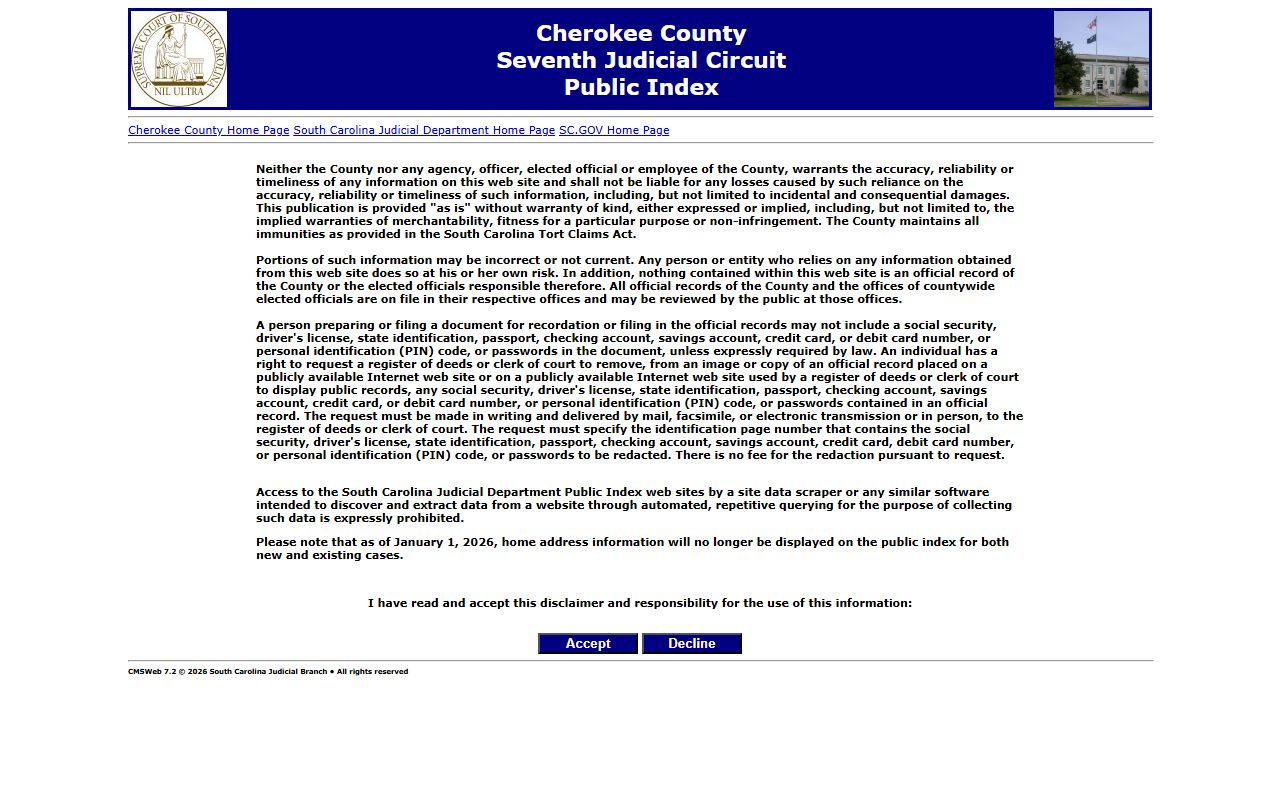
The image shows the browser-based public-index access point, which is the practical route for case records once a Cherokee County arrest becomes a court matter.
Cherokee Court Search Fields
The research did not extract every form label from the Cherokee public index because terminal access returned a browser error. The official judiciary route and Clerk page still confirm that case lookup is browser-based. The supported search approach is therefore described by route and confirmed use, not by invented field names. When the portal is available in a browser, the core task is to match the defendant or case number to a court file and then read the docket entries.
| Field / Route | Type | Required | Notes |
|---|---|---|---|
| Cherokee Public Index | Browser portal | JavaScript and cookies | Official county public-index route for local court records. |
| South Carolina Case Search | State landing page | Browser support | Links to county public indexes across the state. |
| Defendant name | Search input | Portal-dependent | Use when the case number is unknown. |
| Case number | Search input | Portal-dependent | Use when a warrant, bond paper, or court notice gives the number. |
| Court rosters | Docket portal | Browser support | Used for upcoming court dates in the Seventh Judicial Circuit. |
A search may fail when a person was booked very recently, when the case is still in a magistrate or municipal stage, when a charge was not filed, or when a record is restricted. A no-result page does not prove that no arrest occurred. It only means the searched court source did not return a matching public case at that time.
Cherokee Arrest Charging Documents
The path from arrest to court records usually moves through one or more charging documents. A complaint can start a lower-level case or support an initial charge. An information is a prosecutor-filed charging document used in some criminal matters. An indictment is returned through grand-jury action and is common in serious General Sessions cases. Cherokee County is in the Seventh Judicial Circuit, so the solicitor's review is central when an arrest charge becomes a formal state prosecution.
| Document | Who Uses It | Local Meaning |
|---|---|---|
| Complaint | Law enforcement or prosecutor | May begin or support a charge after arrest, often before later review. |
| Information | Solicitor | Can state the formal charge the prosecutor elects to pursue. |
| Indictment | Grand jury | Moves a serious criminal accusation forward in General Sessions court. |
The table is a court-record aid, not a promise that each Cherokee County case will show all three documents. Some matters remain in summary court. Others move into General Sessions. A charge may also be amended, reduced, dismissed, or handled by plea. The docket should be read event by event.
Cherokee Charge Status Records
Cherokee County court records after a jail arrest can show a charge status that differs from the jail booking entry. The jail entry is tied to intake and custody. The court entry is tied to prosecution, court hearings, and disposition. If the solicitor changes the charge, the public index may show a formal charge that does not match the first booking label. That is normal in criminal case processing and should not be read as a data error without checking the docket.
| Status | What It Means |
|---|---|
| Pending | The charge is open and no final disposition has been entered. |
| Amended | The charge wording, level, or code changed after review or court action. |
| Reduced | The prosecution moved forward on a lesser charge than the original booking accusation. |
| Dismissed | The charge was ended by court action and is not a conviction. |
| Nolle prosequi | The solicitor chose not to prosecute that charge at that point in the case. |
| Disposition | The case has a recorded outcome, such as plea, verdict, dismissal, or sentencing entry. |
For prosecution context, the source inventory includes the Cherokee County solicitor page.

The solicitor source connects arrest charges to prosecution review, which is why court records can change after the booking record first appears.
Cherokee Arrest Bond Records
Bond information is part custody, part court record. South Carolina law allows release on personal recognizance for many noncapital charges, subject to conditions. A court can also allow cash bond, a ten-percent cash deposit in some settings, surety bond through a bondsman, electronic monitoring conditions, or no bond. Magistrate bond hearings and deposits in lieu of recognizance are addressed in the state magistrate and bail statutes. The practical rule is simple: verify bond with the court or jail before paying anything.
| Bond Type | How It Works |
|---|---|
| Personal recognizance | Release based on a promise to appear and comply with court conditions. |
| Cash bond | Money is posted with the court or authorized office under the court's order. |
| Ten-percent deposit | A court may allow a deposit not exceeding ten percent of bond under state law. |
| Surety bond | A licensed surety or bondsman posts bond, subject to court and jail confirmation. |
| No-bond hold | Release is blocked because bond is denied, not set, or overridden by another hold. |
A bond amount on one case does not always mean release is available. Another agency hold, probation or parole hold, SCDC issue, federal hold, ICE detainer, or bench warrant can keep a person in custody. The detention center phone line is the custody check. The court record is the case-status check.
Cherokee Warrants and Arrest
The official Zuercher portal bundle includes a warrants module, even though the sheriff site does not promote it as clearly as the inmate search. The research treats it as an official portal capability that may be enabled in a browser, not as a guaranteed complete statewide warrant list. Warrant search fields exposed in the templates include name, race, sex, age or date of birth logic, bond amount, and charge. Results can include name, race, sex, date of birth or age, bond amount, and charge.
Warrants affect court records after arrest in several ways. An arrest warrant can lead to jail booking and a new case. A bench warrant can arise from an existing court case when a person fails to appear or violates a court order. A fugitive or hold warrant can prevent release even when a local bond appears available. A search warrant is different because it authorizes a search of a place or property and is not the same thing as a custody warrant.
Note: A warrant entry, jail booking entry, and court docket can all describe the same event from different official systems.
Charge vs Conviction
A charge is an accusation. A conviction is a final outcome after a guilty plea, verdict, or other qualifying disposition. Cherokee County court records after an arrest can show charges that never become convictions. They can also show convictions for charges that were reduced from the original booking language. Public readers should avoid treating the roster charge, warrant charge, or pending court charge as proof that the person was convicted.
| Issue | Charge | Conviction |
|---|---|---|
| Stage | Accusation after arrest or prosecutor review. | Final result after plea, verdict, or qualifying court action. |
| Proof | Based on probable cause or filed accusation. | Requires the criminal standard applied in court. |
| Record meaning | Shows what was alleged or filed. | Shows that the case ended with guilt or conviction entry. |
| Custody effect | May support bond, holds, and court dates. | May support sentencing, probation, or SCDC transfer. |
Sealed vs Expunged Records
South Carolina public-record rules permit access to many law-enforcement and court records, but access is not unlimited. South Carolina FOIA gives a right to inspect or copy public records subject to exemptions, fees, and deadlines. Section 30-4-50(A)(8) makes public reports that disclose the nature, substance, and location of crimes or alleged crimes, while allowing exempt information to be deleted. Expungement is a separate legal process under South Carolina expungement statutes.
| Issue | Sealed | Expunged |
|---|---|---|
| Public visibility | Restricted from ordinary public access. | Removed through a statutory expungement process if eligible. |
| How it happens | By court rule or order that limits access. | By court order under the applicable South Carolina expungement statute. |
| Online effect | May hide or limit public display. | May require removal of eligible internet-based public records in the covered context. |
| Where to ask | Clerk of Court or the court handling the file. | Clerk of Court, Solicitor, or qualified legal counsel. |
Section 17-22-950 specifically addresses summary-court expungement orders and removal of internet-based public records in that context. It should not be read as a promise that every dismissed Cherokee County arrest record vanishes automatically from every system. Eligibility depends on the case, the court, and the statute used.
Cherokee Court Record Limits
Public access has boundaries. Juvenile records, sealed charges, protected victim information, sensitive identifiers, and active investigative material may be withheld or redacted. South Carolina FOIA Section 30-4-40 contains exemptions, and Section 30-4-50 allows law-enforcement agencies to delete exempt material from reports that are otherwise public. For county records outside the court docket, the Cherokee County FOIA page gives request routing, deadlines, and fee policy.
Cherokee County states that written FOIA responses are due within ten working days for records not older than two years, with production due no later than thirty calendar days after the response date. Older records have a longer response and production window. Fees may apply based on staff time and copying. Court records, however, often follow clerk and court procedures rather than sheriff FOIA routing.
Important: Court, jail, and warrant data are public-record references, not consumer reports for employment, housing, credit, insurance, or similar decisions.